Stop Serial Free Trial Abuse. One Free Trial Per Device.
Serial abusers rotate throwaway emails, VPN locations, and incognito tabs to exploit your product without paying. Trial Guard anchors each signup to the physical device in <8ms — stopping repeat trials cold without adding signup friction.
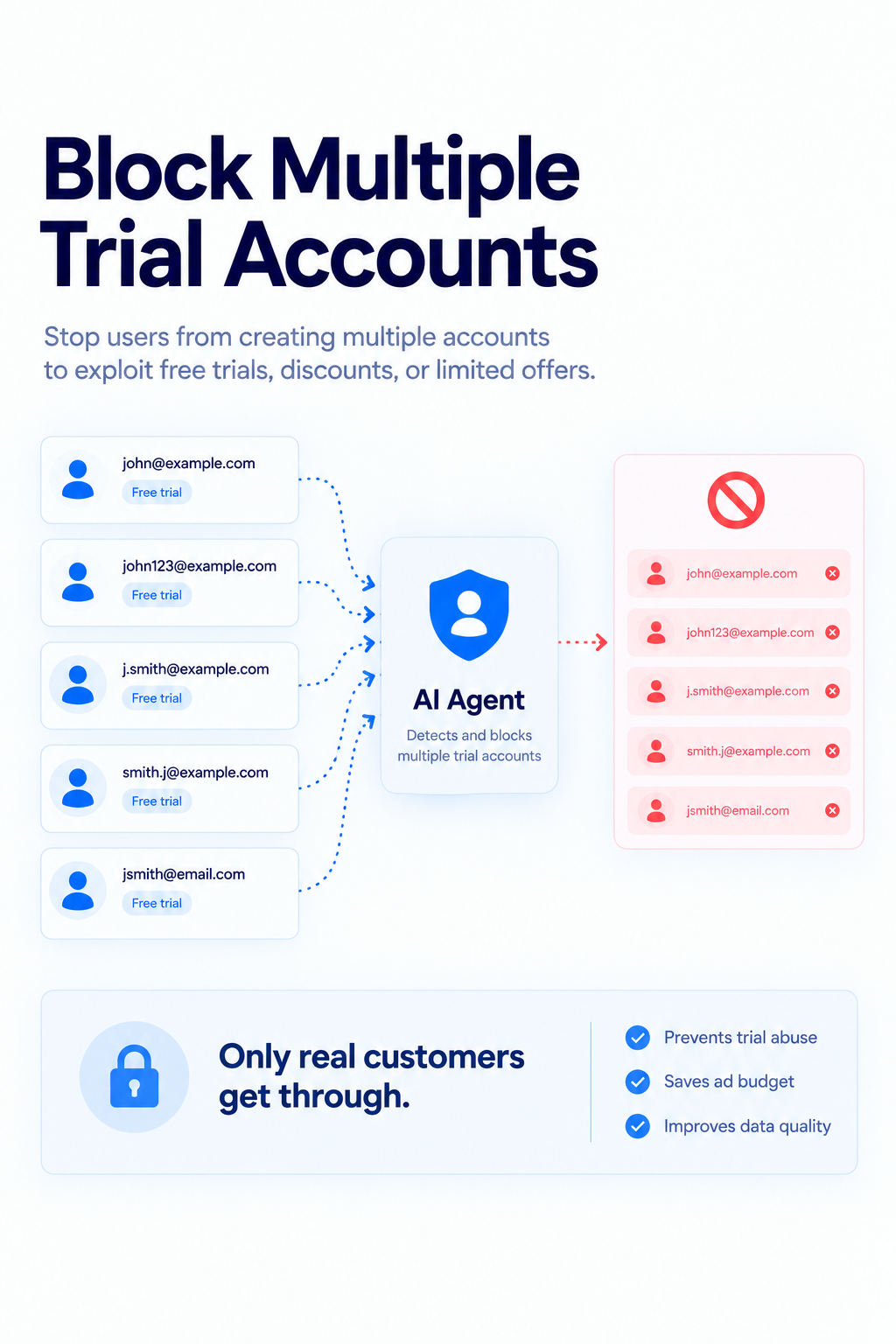
Why standard email verification fails to stop trial fraud
Temporary email services, catch-all domains, and virtual card generators make email verification useless. Here is how Trial Guard protects SaaS recurring revenue at the physical hardware layer.
A Stable Device Signature Survives VPNs, Incognito, and Cleared Caches
Cookie-based tracking and IP blocking fail when abusers toggle a VPN or open Private Browsing. In under 8ms, Trial Guard’s lightweight client collector (st-tg.js) analyzes subtle hardware entropy variations that abusers cannot hide.
- Multi-Vector Hardware Entropy: Canvas GPU rendering artifacts, WebGL shader tolerances, AudioContext waveform phase delays, and CPU clock drift.
- Window Resize Immunity: Abusers who resize their browser windows or rotate screen orientations cannot fool the underlying hardware signature.
- Sub-8ms Execution: Runs completely asynchronously prior to form submit without causing input lag or slowing page render.
Enforce Exactly How You Want: Monitor, Challenge, or Block
Every company has different tolerance levels. Trial Guard lets you choose your enforcement posture per domain or page with a simple toggle on your dashboard.
- Monitor Mode (Silent Audit): Quantifies repeat device attempts in real time without altering signup flow or alerting users.
- Challenge Mode: Prompts repeat devices for SMS verification or credit card authorization ($0 authorization hold).
- Block Mode: Refuses new trial issuance on the repeat device and redirects to log into their existing account.
Pre-Signup Verdict Engine
Per-Domain SHA-256 Ledgers with 100% Fail-Open Reliability
Your customer trust is paramount. Trial Guard stores no plaintext emails or invasive personal telemetry, and guarantees that legitimate signups are never interrupted by technical hiccups.
- Salted HMAC Email Ledger: Emails are hashed immediately with domain-specific cryptographic salts; raw addresses are never retained.
- Fail-Open Guarantee: If the verification API times out or is unreachable, the user passes through. You never lose a customer to downtime.
- OAuth & SSO Shield: Fully compatible with Google Sign-In, GitHub OAuth, and Apple Login with zero iframe interference.
Cryptographic Ledger
GDPR, CCPA, and SOC-2 aligned. Isolated SHA-256 signatures per domain guarantee zero third-party cross-site tracking or data sharing.
Protecting your trial funnel from repeat exploitation
1. B2B & Developer SaaS
Stop freelancers and small agencies from signing up for a new free trial every 14 days to run client deliverables without paying your team.
2. AI Generation & Compute APIs
Prevent token drain and GPU burning from serial abusers who script automated signup bots to exploit free credit quotas.
3. Self-Serve Subscription Products
Enforce fair trial usage while maintaining zero friction for honest prospects, driving them to convert naturally into paid plans.
The sub-8ms pre-signup verification lifecycle
Hardware Sampling (<8ms)
When the signup form loads, client hardware entropy (Canvas, WebGL, AudioContext) is sampled asynchronously without UI blocking.
Domain Ledger Check
The device signature is checked against your domain's SHA-256 ledger in <15ms via Seatext's global edge network.
Apply Configured Action
New devices receive immediate trial access; recognized repeat devices are challenged, audited, or blocked per your policy.
Secure Token Generation
Successful registrations link device and salted HMAC email to ensure future repeat attempts are blocked permanently.
Trial Guard vs Traditional Anti-Abuse Methods
| Feature / Defense Layer | Email Verification / CAPTCHA (reCAPTCHA, Turnstile) | FingerprintJS Pro ($$$) | Seatext Trial Guard |
|---|---|---|---|
| Survives VPNs & Incognito Tabs | No (easily bypassed) | Yes | Yes (Hardware-anchored) |
| User Signup Friction | High (annoying puzzles, delays) | Low (invisible) | Zero (<8ms background check) |
| Fail-Open Guarantee | Varies (can block real buyers) | Requires custom backend code | 100% Fail-Open Built-In |
| Integration Complexity | Requires backend secret keys & webhooks | Complex SDK & server token validation | 1 Script Tag, Zero Dev Required |
| Enforcement Actions | Binary Pass/Fail puzzle | Raw visitor ID only; you write logic | Pre-built Monitor, Challenge, Block |
Questions about Trial Guard
What prevents someone from just clearing their cookies or using an incognito window?
Trial Guard does not use browser cookies or local storage as primary identifiers. Instead, it measures physical rendering hardware variations (GPU hardware artifacts, WebGL shader math differences, AudioContext sample clock skew) that exist physically on the device regardless of browser mode.
What if multiple coworkers on the same office Wi-Fi sign up?
Because Trial Guard identifies the physical device and not the external IP address, each coworker’s laptop or phone produces a unique hardware fingerprint. All legitimate coworkers can claim their own free trials without interfering with one another.
What if a legitimate user buys a refurbished or used laptop?
Ledger records expire automatically after customizable retention windows (e.g. 90 or 180 days). Furthermore, you can use Challenge Mode instead of Block Mode, giving new owners a simple SMS or email verification path to claim their trial.
Can I test Trial Guard before turning on active blocking?
Yes! In fact, we recommend starting with Monitor Mode. Monitor Mode tracks repeat device trial requests silently in your dashboard, showing you the exact percentage of your signups that are serial trial abusers before you enable active enforcement.
Protect your free trial funnel in under 60 seconds.
One line of code. Hardware-anchored verification. Real-time protection.
