Turn your website into an MCP server for ChatGPT & Claude
Every Seatext website gets a machine-readable twin. When shoppers and autonomous enterprise AI agents ask Claude or ChatGPT to find products on your site, Seatext provides verified catalog targets, variant selections, and instant cart actions—with 1 line of code and zero backend engineering.
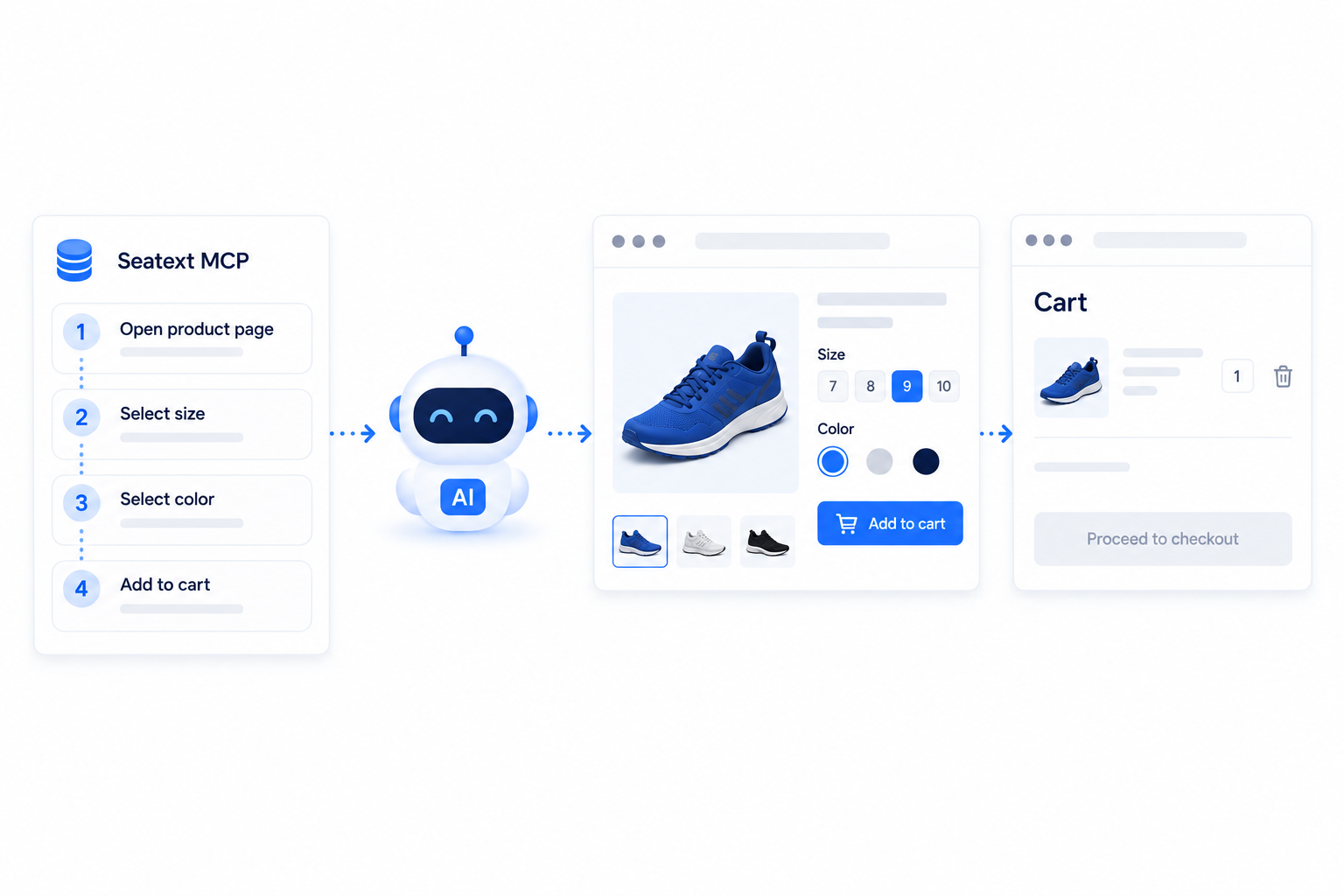
Zero developer weeks
No REST endpoints, OAuth tokens, or webhooks to build. Seatext reads your live DOM and creates your MCP endpoint automatically.
Never breaks on DOM changes
Unlike brittle scrapers, Seatext's Page Understanding Engine classifies semantic roles. If your CSS changes, AI actions keep working.
Enterprise security & cart boundaries
Actions execute inside the buyer's real browser session with enterprise infosec boundaries. Terminal state is strictly the cart—humans confirm payment.
AI assistants are shopping for your customers. Can they interact with your site?
In 2026, millions of buyers and enterprise procurement teams use Claude in Chrome, ChatGPT Atlas, Comet, and Operator to find and purchase products. But generic AI agents struggle on JavaScript menus, mis-guess buttons, and get blocked by bot detectors.
| Capability | Generic AI web browsing | OpenAI ACP / Shopify UCP | SEATEXT WebMCP |
|---|---|---|---|
| Engineering Effort | None (unreliable) | 2–4 weeks developer time, REST APIs | 1 Line of Code (Instant) |
| DOM & Variant Resilience | Breaks on React / CSS updates | Requires API updates per schema change | Page Understanding Engine auto-adapts |
| Shopping Cart State | Dies when AI session closes | Headless server-side cart handover | Native browser session & cookies |
| Discovery & Manifest | Guesses HTML tags | Requires platform plugin | Auto-serves /.well-known/ai-site.json |
| Payment Security | Unsafe credential prompts | Stripe / Merchant integration | Cart-only boundary; Human confirms checkout |
Four autonomous layers between your store and external AI agents
From instant discovery to verified browser replay, here is how Seatext makes your website agent-ready.
Passive DOM classification
Seatext indexes product cards, size selectors, color swatches, and add-to-cart buttons into semantic role maps without performance overhead.
MCP protocol endpoint
Your site automatically hosts /mcp and /.well-known/ai-site.json on your first-party proxy domain with standard JSON-RPC 2.0 tools.
Deterministic Planner
When an AI agent requests an action, Seatext translates fuzzy intent into exact role+label steps with verification checkpoints. No CSS selectors.
Native browser execution
The agent executes the steps or the user opens the signed link. The item is in their real cart, ready for normal human checkout.
Live website structure into standard MCP tools
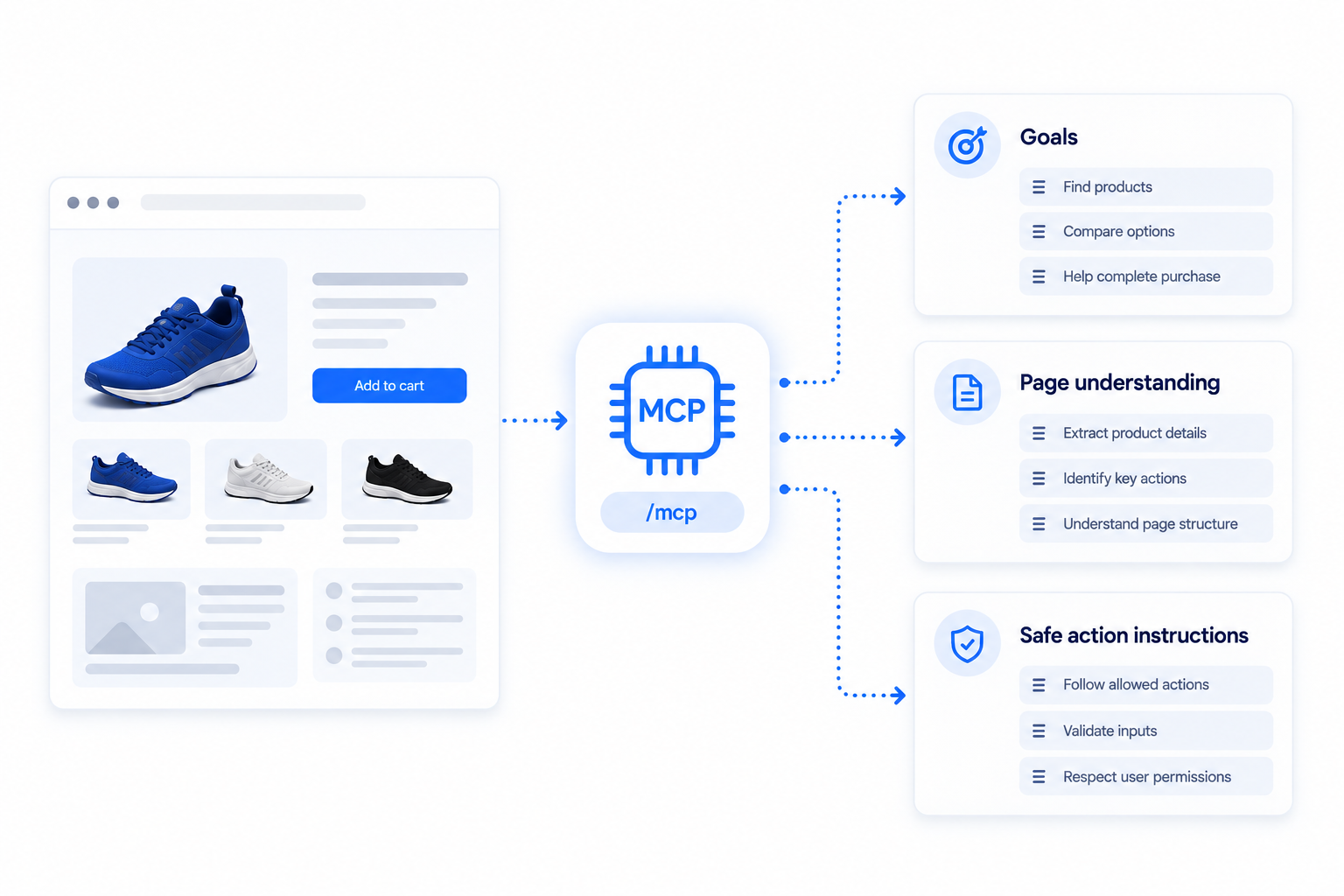
Unlike brittle web scrapers that fail the moment your CSS changes, Seatext's Page Understanding Engine indexes the semantic roles of your interface—products, options, and actions—and maps them into clear JSON-RPC 2.0 tools.
AI assistants discover structured goals (find_products, compare_options, get_instructions) with no API engineering.
Identifies key DOM targets by role, option value, and human-visible label, preserving reliable agent navigation through website redesigns.
Publishes /.well-known/ai-site.json and first-party /mcp endpoint so ChatGPT, Claude, and Codex connect with zero setup.
Supports agentic browsers and chat-only assistants
Whether the shopper uses Claude in Chrome or a mobile ChatGPT chat, WebMCP handles the handoff seamlessly.
For agentic browsers (Claude, atlas, comet)
The external AI agent drives the browser tab directly. Seatext provides numbered, descriptive instructions (role + visible text) with failure checkpoints. The agent clicks native buttons, and the cart is populated in the user's active session.
- Zero CSS selector brittleness
- Instant recovery on out-of-stock sizes
- Zero changes to checkout flow
For Chat-Only Assistants (ChatGPT Mobile)
For assistants without browser automation, WebMCP generates a secure, signed handoff link. When the customer taps the link, seatext.js replays the pre-verified cart actions in their browser in under 300ms.
- HMAC cryptographically signed plans
- No server-side cookie sharing risks
- Customer arrives directly at pre-filled cart
Configurable action permissions with strict payment safety
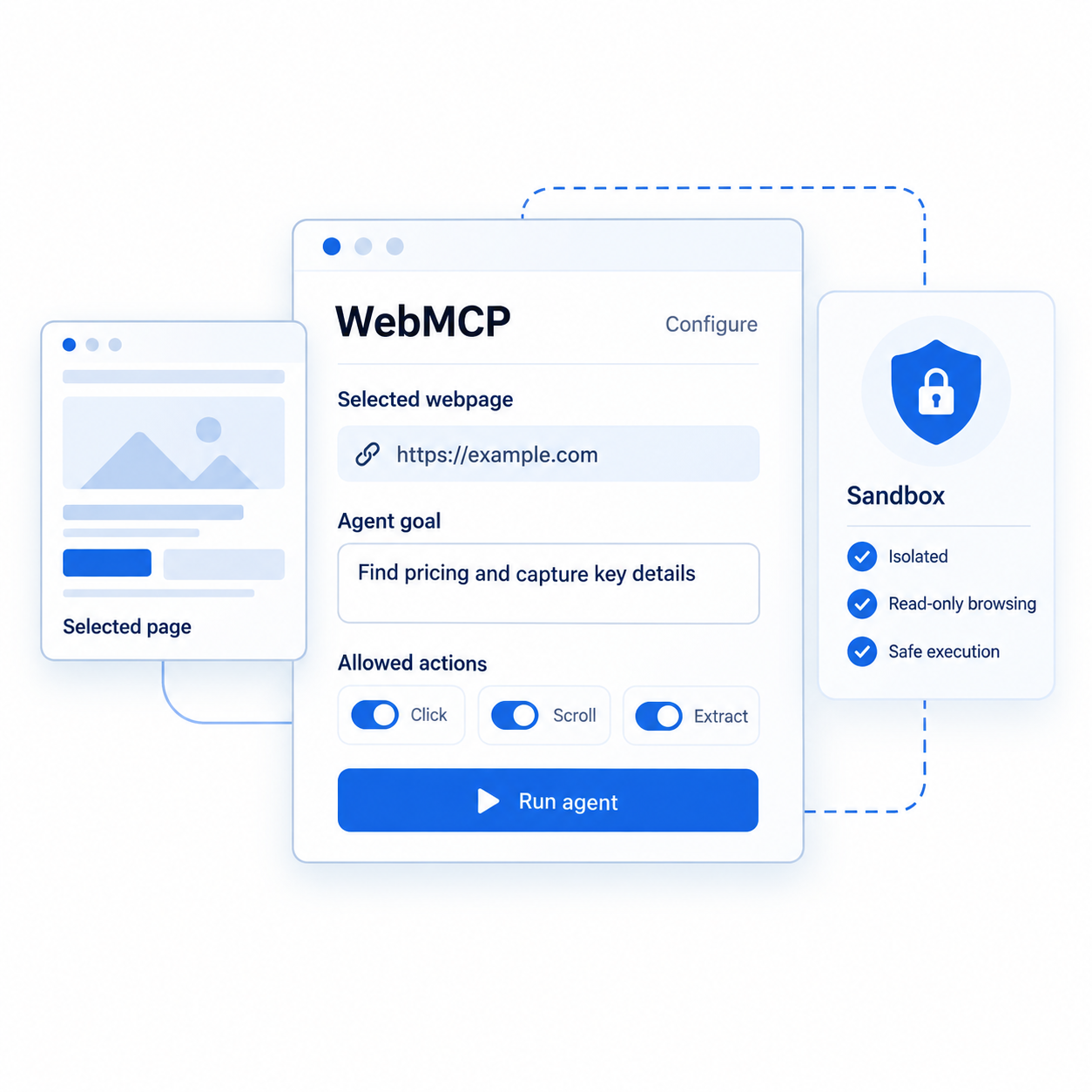
WebMCP gives website owners surgical governance over what AI assistants are allowed to do. Set plain-language agent goals and toggle permitted interaction primitives—with absolute certainty that checkout is protected.
Select which capabilities are permitted per page: click buttons, scroll content, or extract product data in a strictly read-only sandbox.
AI tools populate items into the active shopping cart and stop. Payment details, credentials, and order authorization are forbidden at protocol level.
Actions execute inside the customer's native browser session without transmitting sensitive credentials across third-party LLM providers.
Everything you need to know about WebMCP
Clear answers on Model Context Protocol, autonomous AI agent shopping actions, security boundaries, and platform compatibility.
What is Model Context Protocol (MCP)?
Model Context Protocol (MCP) is the open standard backed by Anthropic, OpenAI, Microsoft, and Google that allows AI models to safely discover tools and take actions on external services.
WebMCP brings native MCP support to any website automatically, allowing ChatGPT and Claude to discover and interact with your site.
Do I need to rewrite my APIs or build webhooks?
No. Unlike standards like ACP or UCP that demand custom backend REST endpoints and OAuth infrastructure, Seatext WebMCP works from your website's live structure using the Page Understanding Engine.
You install one line of code, and your MCP server goes live without backend engineering.
Can an AI agent place fraudulent orders or steal payment info?
Never. WebMCP enforces strict safety boundaries: tools are strictly limited to searching, selecting options, and populating the shopping cart or lead form.
Payment details, passwords, and order finalization are forbidden at the protocol level. The real human customer confirms and completes payment.
Which platforms does WebMCP support?
WebMCP works on any website or e-commerce platform including Shopify, WooCommerce, Magento, BigCommerce, Webflow, Squarespace, Wix, Next.js, and custom web applications.
